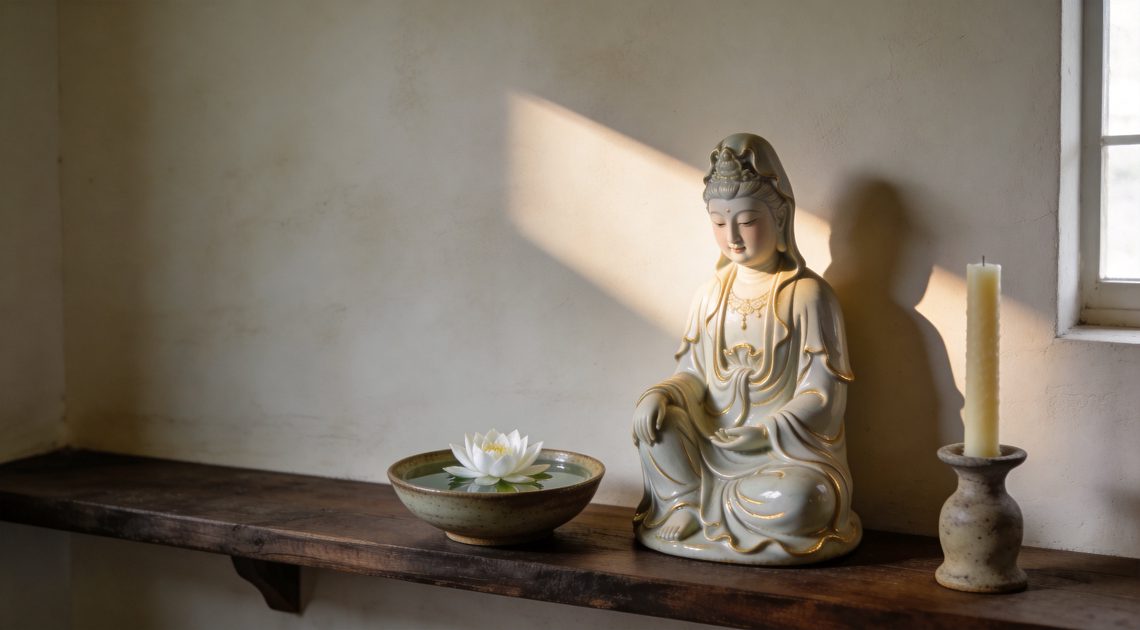
Walk into a temple, and you know it. Something in the air shifts. The objects in the room — a carved figure, a bowl of water, a single flower — are not merely beautiful. They are present in a way that decorative objects rarely are. You would not pick them up casually. You would not rearrange them to suit your mood. They hold the space rather than filling it.
Now consider a home. A Kwan Yin statue on a meditation altar. A small stone brought back from a pilgrimage, sitting on a windowsill. A ceramic bowl, handmade and used only for tea, never for anything else. These objects are not necessarily more beautiful or more expensive than the other things in the room. But they feel different. They carry a weight that has nothing to do with physical mass.
What makes an object feel sacred rather than merely decorative? The answer is not in the object itself. It is in the relationship — between the object and its origin, between the object and its owner, and between the object and the space it inhabits. Understanding this changes not just how you choose objects for your home, but how you live with them.
Sacred Is Not a Style
The word sacred has been diluted. It is used to describe candles, skincare routines, and the way someone arranges their bookshelf. In the process, it has come to mean little more than "special" or "meaningful to me personally." But the sacred, in its deeper sense, is not a feeling one generates. It is a quality one recognizes.
Sacred objects are not sacred because they are beautiful. They are sacred because they have been set apart. In every religious and spiritual tradition, the sacred is that which has been removed from ordinary use and dedicated to something beyond the self — a deity, an ancestor, a practice, a truth. A bowl used for offerings is not the same as a bowl used for breakfast cereal, even if they were made by the same potter. The difference is in the dedication.
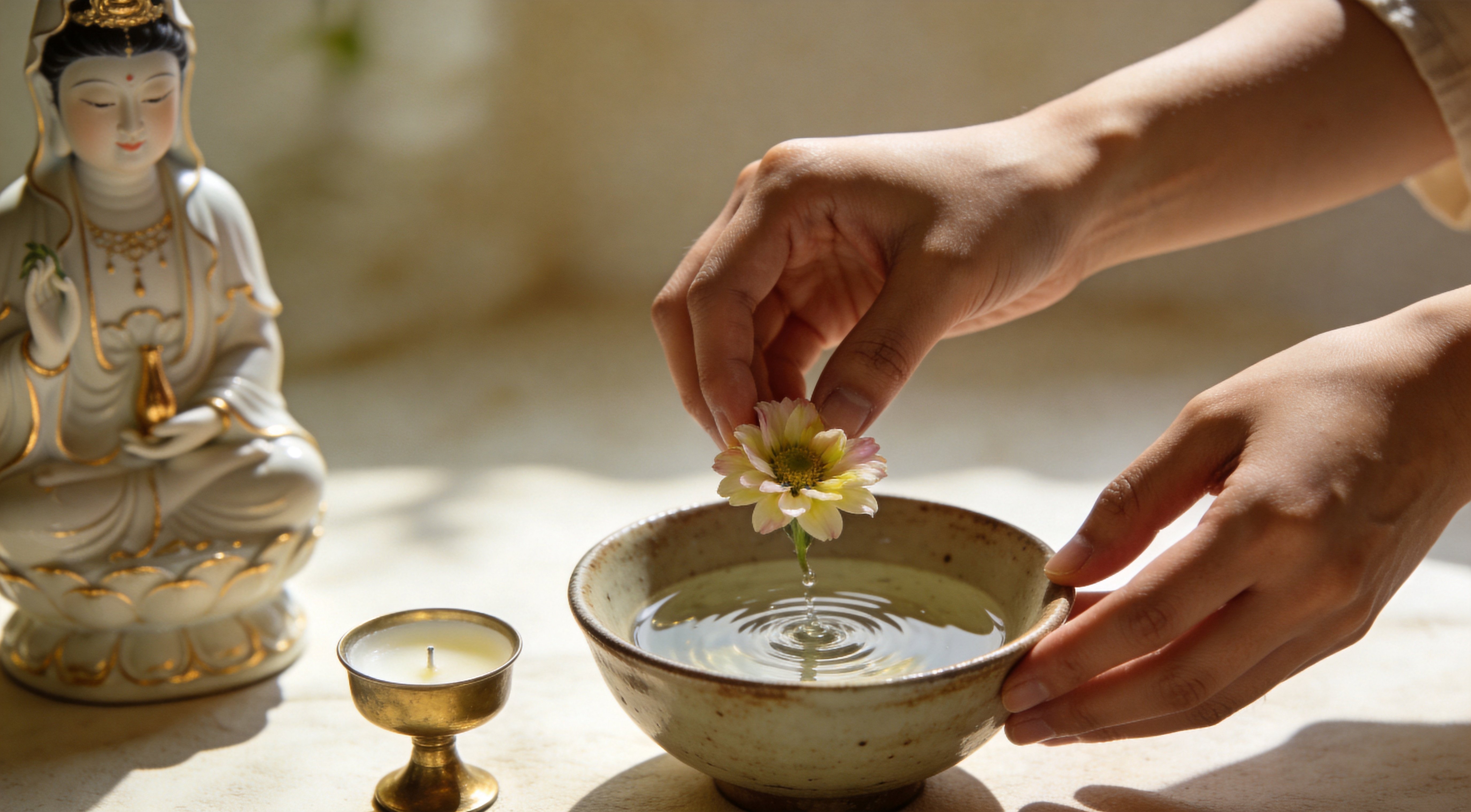
This is the first distinction between sacred vs decorative: the decorative object exists to be looked at. The sacred object exists to serve. It points beyond itself. A Kwan Yin statue on a shelf above a row of novels is decorative. The same statue, placed in a clean, quiet corner with a small cup of water and a flower, becomes something else. Not because the statue changed, but because the context and the intention changed around it.
Intention Is Everything
If you have ever visited a Japanese tea room, you may have noticed the tokonoma — a small alcove containing a single hanging scroll and a simple flower arrangement. The objects in the alcove are not randomly chosen. They are selected with deep intention, often to reflect the season, the occasion, or the feeling the host wishes to offer the guests.
This is the power of meaningful decor: intention transforms the ordinary into something resonant. The scroll is not there to fill a blank wall. The flower is not there because flowers are pretty. They are there to create a moment, to invite attention, to mark a threshold between the ordinary world outside and the quiet world within the tea room.
You can bring this same quality into your own home. Choose one object — it does not need to be religious, it does not need to be expensive — and dedicate a space to it. A small shelf. A corner of a table. Place it there with care. Do not crowd it with other things. Let it be the only object in that space. When you walk past it, acknowledge it. This is the beginning of a relationship with a sacred object, and it has nothing to do with decoration.
The Role of Origin and Story
An object's origin shapes how it feels. A mass-produced Buddha head, bought from a home goods store, carries a different energy than a small Kwan Yin statue carved by a craftsman in a tradition of Buddhist image-making. The first was made to be sold. The second was made to be venerated. The intention of the maker enters the object and stays there.
This is not mysticism. It is attention. A craftsperson who spends weeks carving a single figure, who chants or meditates while working, who treats the making as a form of practice — that craftsperson imbues the object with a quality that cannot be faked. Even if you do not know the maker's name, you can feel the difference. The object has presence.
This is why spiritual home objects are almost always handmade. The hand carries intention in a way that a machine cannot. When you choose an object for a sacred purpose — a small altar, a meditation corner, a place of remembrance — choose one made by someone who understood that the object was meant for more than display.
Relationship Over Time
A sacred object is not static. It changes as your relationship with it deepens. The small bowl you use for morning tea, day after day, accumulates meaning that a decorative bowl sitting untouched on a shelf will never acquire. The worn spot where your fingers rest. The slight staining from years of tea. These are not flaws. They are evidence of relationship.
This is where meaningful decor becomes something more than decor. The object becomes a companion. It witnesses your life. It holds your attention. Over time, it becomes impossible to separate the object from the moments it has accompanied — the morning you received difficult news and sat holding the bowl a little longer than usual, the quiet evening when the light hit the glaze just so and you stopped to notice.
A decorative object asks for admiration. A sacred object asks for relationship. The first is easily replaced. The second is irreplaceable.
Creating Space for the Sacred at Home
You do not need a temple to invite sacred objects into your life. A corner of a room is enough. A windowsill. The top of a low cabinet. Choose one object that carries meaning for you — a Kwan Yin statue, a smooth stone, a small ceramic cup, a piece of calligraphy — and give it a place of honor. Keep the space clean. Let it breathe. Visit it.
Do not crowd it with other objects. The sacred needs room. This is the principle of ma — meaningful emptiness. The space around a sacred object is not wasted. It is what allows the object to be seen and felt. It is the visual equivalent of silence.
This small practice — choosing one object, dedicating a space, paying attention — can shift the entire atmosphere of a room. Not because the object is magical, but because the attention you bring to it is real. And attention, given consistently, changes things.

No letters yet — be the first to write.