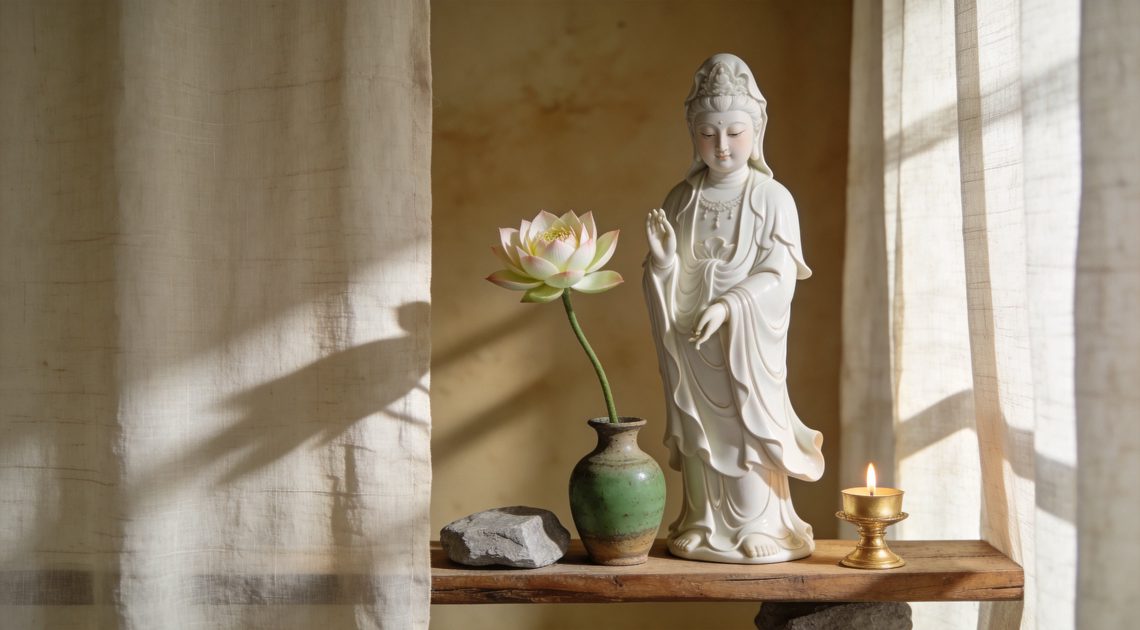
Walk into a meditation room, a temple courtyard, or a quiet corner of someone's home that feels different — softer, somehow — and you may find her there. A Kwan Yin statue, often carved from wood or cast in porcelain, draped in flowing robes, her eyes cast gently downward. She is not looking at you. She is looking toward something within you.
There is a reason her image appears across cultures and centuries: in Chinese temples, Japanese gardens, Vietnamese altars, Korean monasteries, and, increasingly, in the homes of people who may not identify as Buddhist at all. She represents something universal. Something the world rarely offers in large supply.
Compassion. Mercy. The quiet, unwavering presence of someone who sees suffering and does not turn away.
But who is Kwan Yin, exactly? And what does it mean to bring her image into your home?
She Who Hears the Cries of the World
Kwan Yin — also known as Guanyin in Chinese, Kannon in Japanese, and Avalokiteshvara in Sanskrit — is not a goddess in the Western sense. She is a bodhisattva, a being who has attained enlightenment but chooses to remain in the cycle of suffering to help others find liberation. Her full Chinese name, Guanshiyin, translates roughly to "the one who hears the sounds of the world." She hears the cries. She does not turn away.
This is the core of Kwan Yin statue meaning: she is the embodiment of active compassion. Not pity from a distance, but the kind of mercy that leans in. That reaches toward. That stays.
In early Buddhist iconography, Avalokiteshvara was often depicted as male. But as devotion spread through China and East Asia, the figure gradually transformed — becoming feminine, maternal, a presence that feels less like a distant deity and more like a compassionate mother who sees you clearly and loves you anyway. By the Song Dynasty, the female form of Kwan Yin had become the dominant representation, and it is this image that has endured.
What a Kwan Yin Statue Represents
A Kwan Yin statue is not an idol in the Western religious sense. It is a reminder. A presence. A focal point for a certain quality of attention.
She is often depicted holding a willow branch, symbolizing her ability to bend without breaking — to remain flexible in the face of suffering. In her other hand, a vase of pure water, representing the cleansing of pain and the nourishment of compassion. Sometimes she stands on a lotus pedestal, a symbol of purity rising from muddy waters. Other times she is seated in meditation, her posture a quiet instruction: this is how we meet suffering. Not by running. By sitting still enough to hold it.
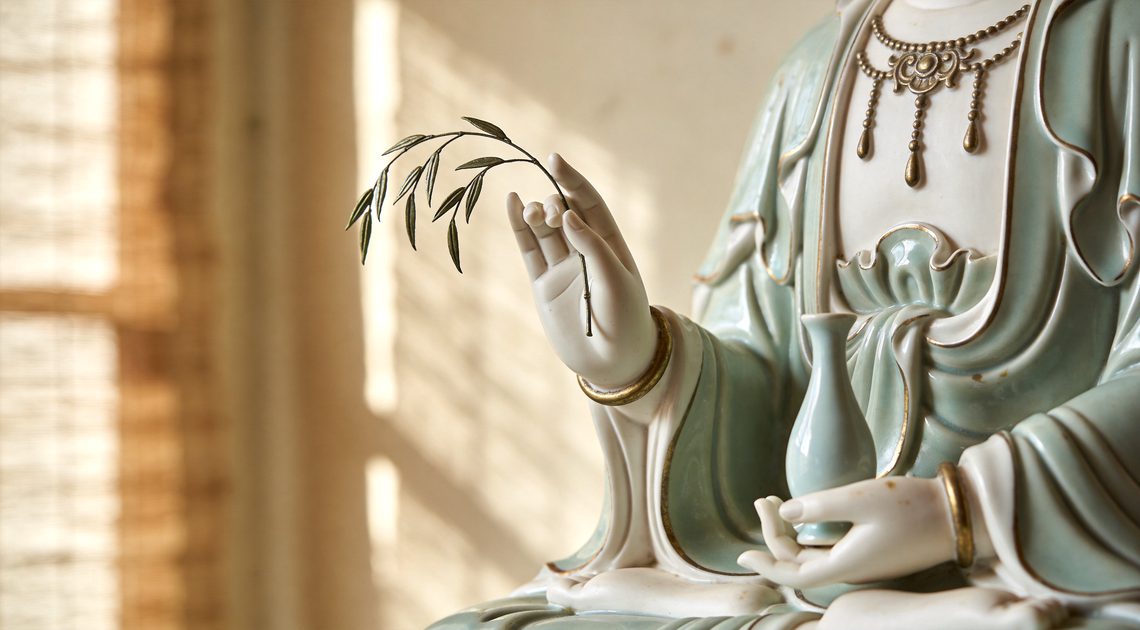
For those who keep a Guanyin statue in the home, these symbols are not decorative. They are daily, wordless teachings. A reminder to meet difficulty with softness. To listen before speaking. To offer mercy — to others, and perhaps harder still, to oneself.
Placing Kwan Yin in Your Home
There is a certain care required when bringing a sacred image into a personal space. Not because Kwan Yin demands ritual precision, but because reverence itself is a practice worth cultivating.
Traditionally, a Kwan Yin statue is placed in a clean, elevated position — never directly on the floor, never in a bathroom, never facing a wall or a cluttered corner. A small table or a dedicated shelf works beautifully. Some choose to place her in a meditation space or a quiet corner of the living room. Others keep her in the entryway, so that compassion is the first thing one meets when coming home.
What you place around her matters less than the intention you bring. A simple arrangement — a single fresh flower, a small cup of water, an unlit candle — is enough. The offering is not for her. It is for you. A gesture that says: I am paying attention. I am practicing presence.
A word of cultural respect: Kwan Yin is not interchangeable with generic "zen decor." She carries centuries of devotion across multiple living traditions. To bring her image into your home is to enter into relationship with that history. Treat her as you would a honored guest, not a design accessory. The difference will be felt.
Why She Resonates Now
We live in a moment of extraordinary noise. The cries of the world are no longer distant — they arrive through our screens, hourly, unrelenting. It is easy to grow numb. Easy to turn away because facing it all feels impossible.
Kwan Yin offers a different response. She hears everything and does not shatter. She stays. Her image, placed quietly in a room, becomes a small anchor. A visual reminder that compassion is not weakness. It is the most demanding practice there is — and the most needed.
For some, the Kwan Yin statue meaning is explicitly spiritual. For others, it is symbolic, philosophical, or simply grounding. There is no requirement to believe in any particular doctrine. The only requirement is to approach her with sincerity.
Living With Her Presence
Over time, something subtle happens. You walk past her in the morning and feel a brief softening. You sit near her in the afternoon and find your breathing slower. You are not praying, necessarily. You are simply sharing space with an image that has carried the hopes and sorrows of millions of people across more than a thousand years.
That is the quiet power of a Kwan Yin statue. She does not demand. She does not judge. She simply sits, and listens, and reminds you — every day — that compassion is always an option.
Even now. Especially now.
No letters yet — be the first to write.