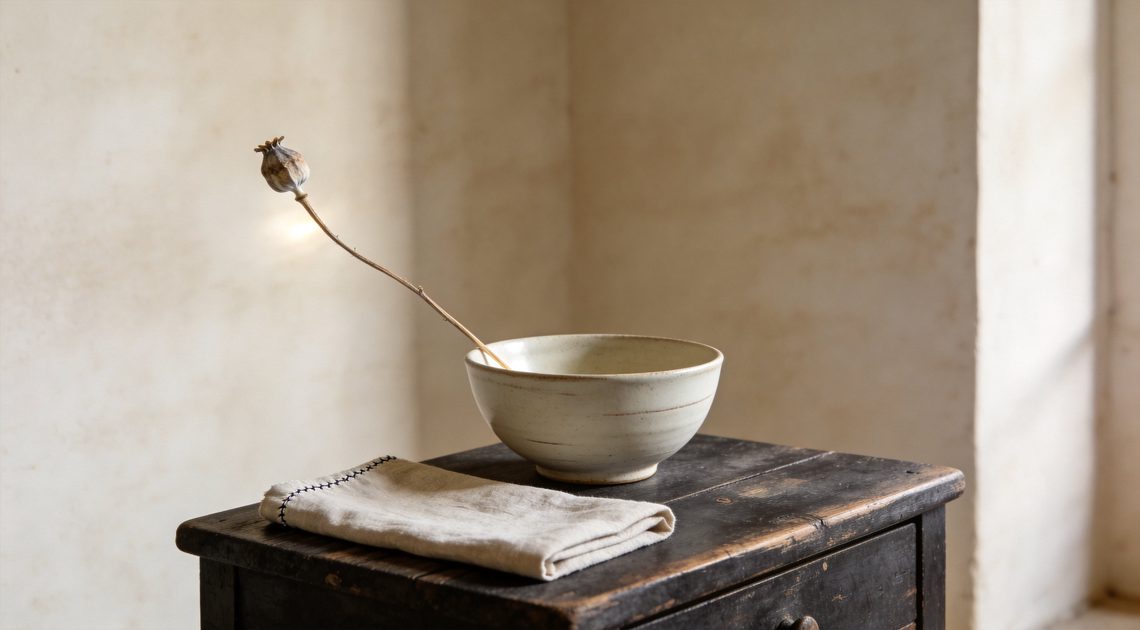
Walk into most homes, and you will find surfaces filled with things that nobody chose. They accumulated. A candle gifted three years ago, never lit. A decorative bowl bought on impulse, now gathering dust. A shelf of small objects that, if you asked the homeowner about each one, would elicit mostly shrugs. "I don't know. It was there. I kept it."
This is not a moral failing. It is the natural result of living in a culture that treats acquisition as the default response to an empty surface. But there is another way — quieter, slower, and far more satisfying. It is called mindful home decor, and it begins not with a shopping list, but with a question: what do I actually want to live with?
The Difference Between Decorating and Gathering
Conventional decorating starts with a room and asks: what does this space need? A rug. A lamp. Something for that empty corner. The process is reactive. The goal is to fill gaps. The result, too often, is a room that looks complete but feels hollow — like a furniture showroom where nobody actually lives.
Intentional decorating starts somewhere else. It starts with attention. It asks: what do I love? What objects carry a story? What materials feel good to my hands? What do I want my eyes to rest on when I walk into this room at the end of a long day?
The difference is felt, not just seen. A room filled with meaningful home objects — things chosen slowly, one at a time, for reasons that go beyond appearance — holds a different kind of silence. It breathes differently. It feels inhabited by someone who knows what they care about.
This is not a style. It is a relationship. Between you and the things you share your space with.
The Case for Fewer Things
There is a practical argument for choosing fewer objects: less dust, less visual noise, less money spent on things that lose their appeal within weeks. But the deeper argument is emotional. When every surface holds five things, none of them matter. They cancel each other out. The eye skims and forgets.
Mindful home decor works in the opposite direction. Take everything off a shelf. Now place one object on it — a hand-thrown ceramic bowl, a small stoneware vase, a book that changed how you think. Notice how that single object suddenly has weight. It occupies the space fully. You see it. You remember it is there.
This is the quiet magic of slow decorating. Fewer objects do not make a room feel empty. They make each remaining object feel significant. The restraint is not about deprivation. It is about giving the things you truly love the room they deserve to be seen and appreciated.
How to Choose Well
If you are only going to live with a handful of things, each one matters. Here is a simple framework for choosing meaningful home objects that will stay with you.
First, choose for the hand. Pick the object up. Hold it. Does it feel good in your palm? Is the weight satisfying? Does the surface invite touch — a matte glaze, a worn wood grain, a linen texture that softens with use? If an object does not feel good to hold, you will stop noticing it. If it does, you will reach for it again and again.
Second, choose for the story. Ask where it came from. Not in a forensic sense, but in a human one. Who made this? What tradition does it belong to? A celadon cup from a potter in Longquan carries the lineage of a thousand-year craft. A silk flower made by hand in a small workshop carries the patience of the artisan who shaped each petal. These stories do not make an object more expensive. They make it more alive.
Third, choose for the long arc. Fast trends look dated within a season. Objects chosen for their connection to a craft tradition or a natural material tend to age in reverse — they grow more beautiful as they wear. The patina on a brass tray. The softened edge of a linen cushion. The subtle crackle in a celadon glaze that deepens with years of tea. These are not flaws. They are the object's life becoming visible.
The Empty Space Rule
There is a principle in mindful home decor that is harder to practice than it sounds: leave some surfaces empty. Not cluttered, not styled, but genuinely bare. A side table with nothing on it. A shelf with a single object and space around it. A corner that holds only light.
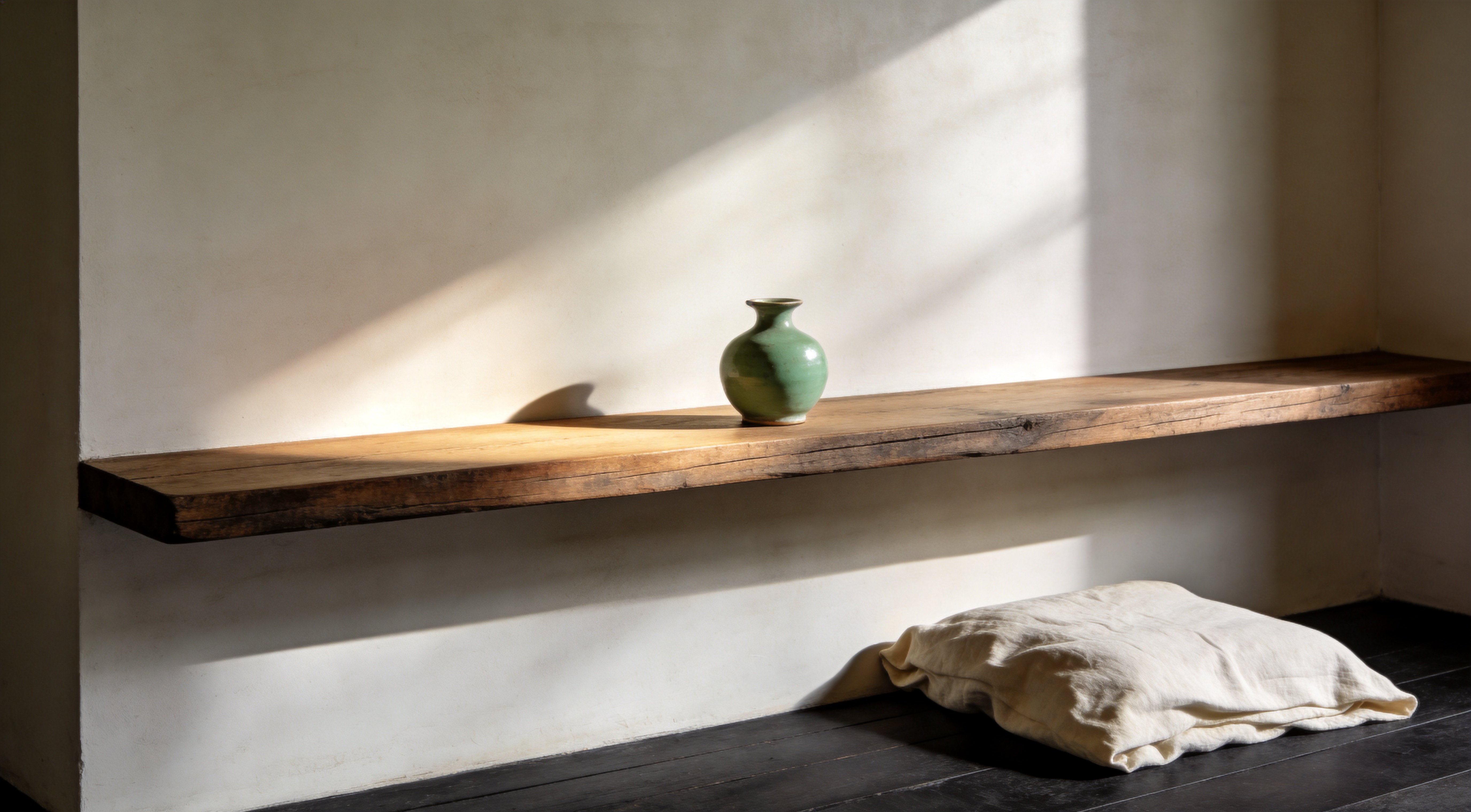
This is uncomfortable at first. Empty space feels like a problem to solve. But over time, you begin to feel it differently. The emptiness becomes restful. It gives your eyes a place to pause. It makes the objects you have chosen feel more deliberate, more special.
In Japanese aesthetics, this is the concept of ma — the meaningful pause, the space between things. It is not absence. It is presence of a different kind. A room with ma feels calm not because it lacks objects, but because every object has been given room to breathe.
A Home That Grows Slowly
The most beautiful homes are not the ones decorated in a weekend. They are the ones gathered over years. A ceramic cup from a trip. A textile found in a small shop and carried home in a suitcase. A piece of art bought directly from the artist, still smelling faintly of the studio. These objects arrive slowly, and they stay.
Slow decorating is not a method. It is a posture. It is the willingness to live with an empty corner for months, waiting for the right thing rather than filling it with something close enough. It is the discipline to buy nothing at all until something speaks to you. And when it does, it is the joy of bringing home something that already feels like it belongs.
A mindful home is never finished. It shifts and breathes with the life lived inside it. But every object in it is there because someone chose it — not to fill a void, but to honor a connection. That is the difference between a room that looks good in photographs and a room that feels good to come home to.
No letters yet — be the first to write.