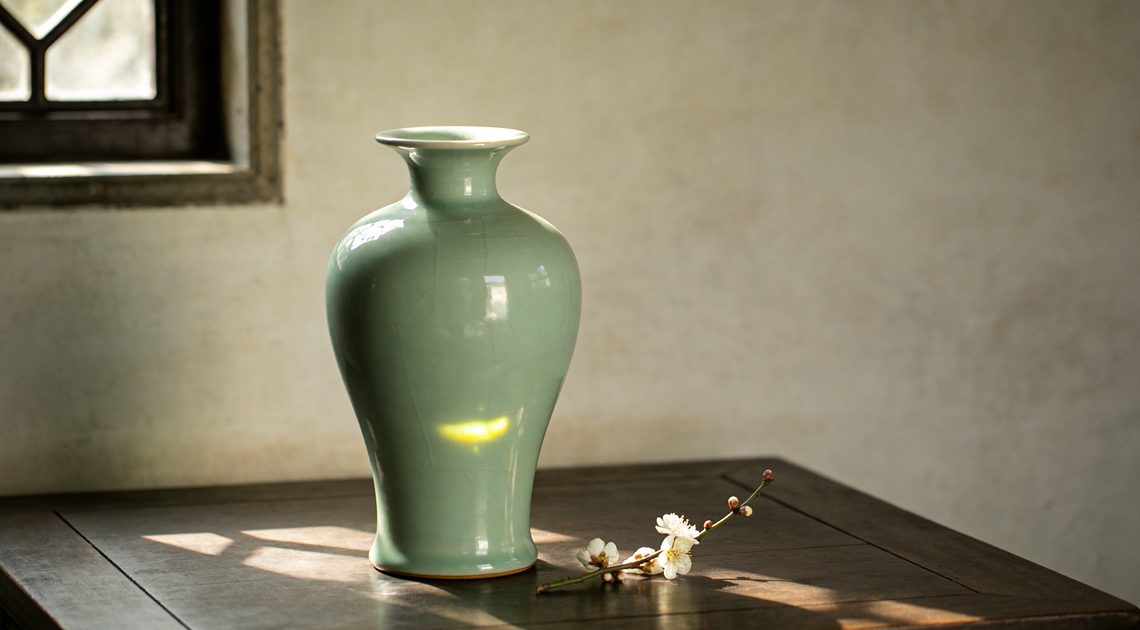
There is a color that refuses to be photographed accurately. You have probably experienced this if you have ever stood before a piece of celadon pottery in a museum or held a small celadon cup in your hands. The glaze shifts with the light — grey-green in the shadows, soft olive in direct sun, somewhere between jade and mist and the surface of a still lake at dawn. No camera quite captures it. Perhaps no word quite captures it either.
This quiet green has been pursued by potters for over a thousand years. Emperors coveted it. Korean scholars revered it. Chinese artisans risked entire kiln loads in pursuit of the perfect shade. And today, celadon ceramics sit in modern homes — not as antiques behind glass, but as objects people use, hold, and live with daily.
Why does this particular glaze endure? The answer is part chemistry, part history, and part something harder to name — a feeling that celadon carries, a quietness that seems to inhabit the glaze itself.
What Is Celadon?
Celadon is not a single color. It is a family of green-glazed stoneware and porcelain, produced by firing iron oxide in a reduction kiln — a process where oxygen is carefully restricted. When the kiln is starved of oxygen, the iron transforms. Instead of turning rust-red or brown, it becomes a translucent green that sinks into the clay body rather than sitting on top of it.
The result is a glaze that feels inside the ceramic, not painted onto it. It has depth. It has movement. Two celadon pieces from the same kiln can emerge with slightly different shades — one leaning toward pale grey-green, another toward a deeper olive — because the fire, the clay, and the atmosphere inside the kiln are never exactly the same twice. Every piece is a conversation between the potter's intention and the kiln's temperament.
The name itself came later, bestowed by European collectors who borrowed the term from a French pastoral play in which a shepherd named Céladon wore pale green ribbons. But the tradition they were naming was already ancient by then.
A History Written in Fire
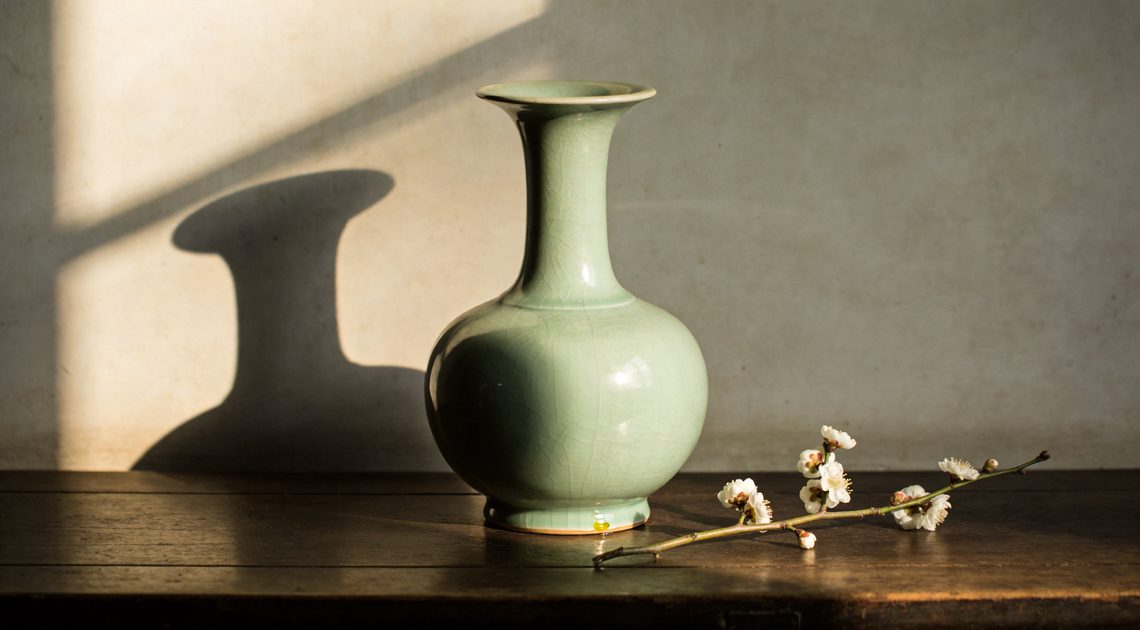
Chinese celadon traces its origins to the Eastern Han Dynasty, nearly two thousand years ago. But it was during the Song Dynasty (960–1279) that the craft reached its artistic zenith. The Song court prized ceramics of quiet restraint — monochrome glazes, elegant forms, nothing excessive. Celadon pottery was the physical embodiment of this aesthetic. No painted scenes. No bold patterns. Just form and color, perfectly balanced.
The most celebrated kilns were in Longquan, in present-day Zhejiang province. There, potters developed a thick, almost unctuous celadon glaze in a range of greens that collectors still refer to by poetic names: "powdered green," "plum green," "sky after rain." The last phrase is revealing. It suggests something fleeting, atmospheric, impossible to pin down.
When celadon ceramics reached Korea during the Goryeo Dynasty, Korean potters took the tradition in their own direction — developing an inlay technique called sanggam that remains uniquely Korean to this day. Meanwhile, in Japan, celadon pieces imported from China became prized treasures of the tea ceremony, valued for the way the green glaze seemed to deepen when touched by matcha.
The Pursuit of Jade
To understand celadon, you must understand jade. For centuries in China, jade was the most revered of all materials — a stone believed to embody virtue, purity, and immortality. But jade was rare and extraordinarily difficult to carve. Celadon pottery offered a different path to the same green.
A successful celadon glaze does not merely look green. It looks jade-like. It has a translucency, a softness, a sense of light held inside the surface rather than reflected off it. This was the potter's quiet ambition: not to imitate jade, but to evoke its spirit in humble clay.
This connection to jade is part of why traditional pottery in the celadon tradition was treated with such reverence. A fine celadon bowl was not simply a vessel. It was an object of contemplation, something to hold, to turn in the light, to appreciate as you would appreciate a landscape painting or a poem.
Celadon in the Modern Home
Today, celadon ceramics are having a quiet renaissance. Not as museum replicas, but as living objects in contemporary interiors. A celadon vase on a wooden shelf. A set of small celadon cups for morning tea. A shallow celadon bowl holding nothing but light and space on a side table.
What makes celadon work in modern homes is the same thing that made it work in Song Dynasty palaces: it does not demand attention. It waits to be noticed. In a room filled with objects competing for your eye, a piece of celadon pottery recedes — and in receding, becomes more present. You notice it slowly. And once you do, you keep noticing it.
This is the quiet power of celadon. It does not match a color scheme. It does not follow a trend. It simply sits, holding its ancient green, and invites you to pause.
The potters of Longquan would have understood this perfectly.
No letters yet — be the first to write.