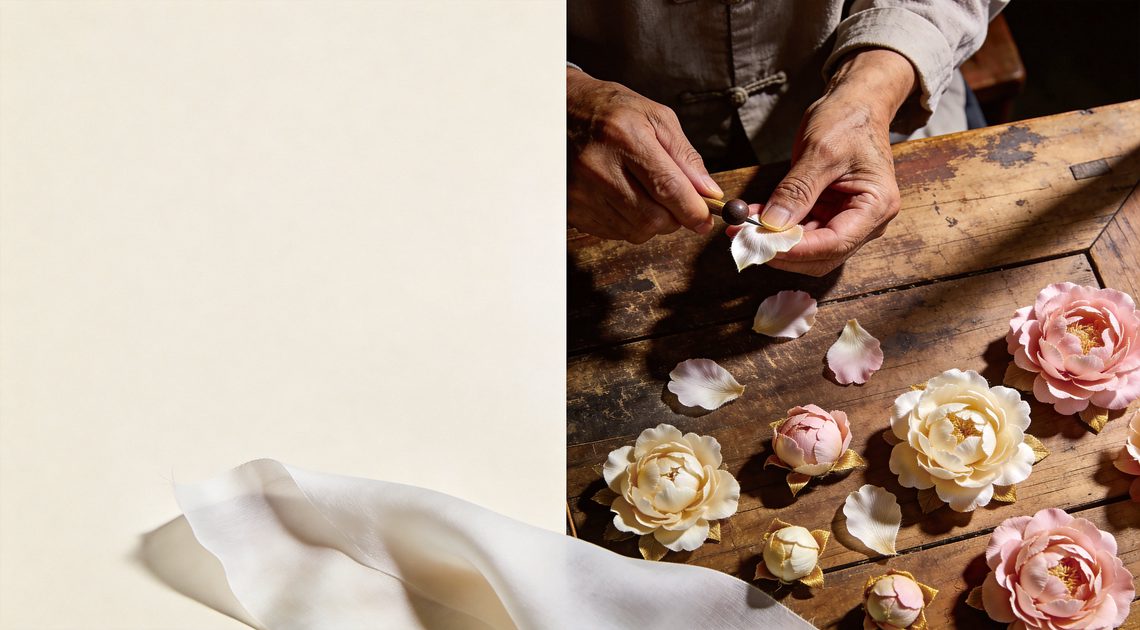
There is a particular kind of silence in a workshop where silk flowers are made. No machines hum. No conveyor belts turn. Just the quiet sound of fabric being cut, folded, pressed — and the slow, deliberate rhythm of a craft that has refused to hurry for over a thousand years.
Chinese silk flower art is not the stuff of craft-store aisles. It is a meticulous, hand-intensive tradition that transforms plain silk into blossoms so lifelike you might lean in to catch their scent. Each petal is cut, dyed, shaped, and assembled by hand. A single peony might take days. A branch of plum blossoms, an entire week. This is not production. This is devotion.
A History Woven in Silk
Silk has been central to Chinese civilization for millennia — the oldest fragments date back over 8,000 years. But the art of shaping silk into flowers emerged later, flourishing during the Tang Dynasty (618–907 AD), an era of extraordinary cultural refinement. Court ladies adorned their hair with silk flowers, believing the blossoms brought good fortune and mirrored the beauty of the natural world without the cruelty of plucking something living.
By the time of the Qing Dynasty, traditional Chinese crafts like silk flower making had become highly specialized. Workshops in Beijing, Suzhou, and Yangzhou developed distinct regional styles. Imperial concubines wore silk flowers arranged in elaborate headdresses. Scholars kept single stems on their desks — a quiet reminder of spring in the depths of winter. The craft was passed down through families, each generation adding its own subtle refinements, never written down in manuals, only taught through patient demonstration.
Then the twentieth century arrived with its factories and injection molds. Handmade silk flowers, requiring hours of labor per piece, could not compete on speed or price. The workshops shrank. The masters aged. A craft that had survived dynasties nearly slipped into silence.
How a Silk Flower Is Born
The process begins with white silk — plain, unassuming, full of potential. The artisan stretches the fabric onto a frame and applies dye with a brush, building color in delicate layers. Unlike printed fabric, the color of a silk flower petal varies subtly from edge to center, just as it does in a living bloom. This is not a flaw. It is a signature of the hand.
Once dyed, the petals are cut — not with a mechanical die, but with shears guided by muscle memory. Each shape corresponds to a specific flower: the rounded curl of a peony, the pointed elegance of a lotus, the tiny teardrops that form a plum blossom.
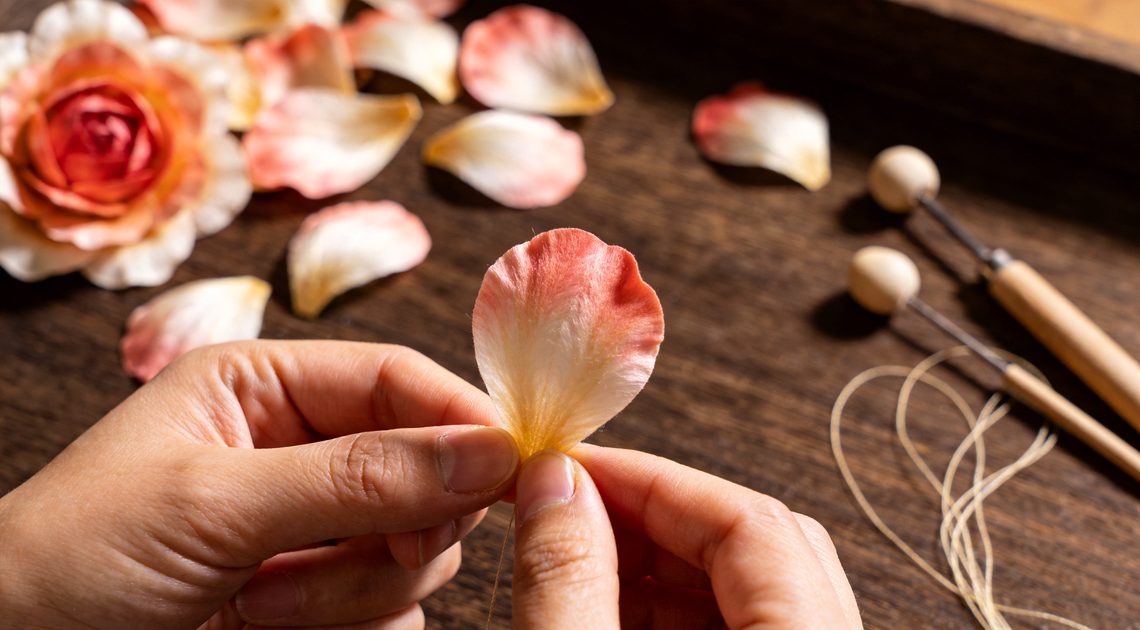
Here is where Chinese silk flower art separates itself from anything machine-made. Each petal must be shaped. Using specialized tools — rounded irons, bone folders, heated balls of varying sizes — the artisan presses and curls the silk until it holds the natural contours of a living petal. Too little pressure, and the form looks flat. Too much, and the silk scorches. There is no undo button. There is only the accumulated intuition of years.
Assembly is the final act. Petals are arranged around a center — sometimes a tiny silk bud, sometimes a cluster of hand-wired stamens — and bound with silk thread. Leaves are added. The stem is wrapped. What was once a flat sheet of white fabric is now a camellia, a lotus, a spray of orchids that will never wilt.
Why This Craft Still Captivates
We live in an age of abundance and acceleration. Objects appear at our doors within hours of a tap on a screen. Most are forgotten within days. A silk flower made by hand is the inverse of all this. It is slow to create. It is irreplaceable. It carries the presence of its maker in every curve and crimp.
There is also something quietly radical about a flower that does not fade. Not as an act of defiance against nature, but as an homage to it — a way of holding onto a moment of bloom that would otherwise pass. In a culture that has long revered the impermanence of cherry blossoms, the silk flower offers a companion truth: sometimes, preserving beauty is its own form of reverence.
And then there is the material itself. Silk is not plastic. It breathes. It catches light. It softens with age in ways that polyester never will. In a world increasingly suffocated by synthetics, silk flowers made from real silk feel like a return to something honest.
Bringing the Craft Home
A single silk flower branch in a stoneware vase can do what a dozen mass-produced stems cannot: hold attention. It invites a closer look. The slightly uneven petal edge. The gradient of color that no printer could replicate. The way the stem bends, just slightly, as if reaching toward light.
This is the gift of traditional Chinese crafts — they do not demand attention. They reward it. Quietly. Patiently. On their own terms.
The next time you encounter a silk flower made by hand, pause. Lean in. Someone, somewhere, shaped that petal with their fingers, one by one, believing that beauty worth making is beauty worth taking time over.
In a world that rushes, that is no small act of grace.
No letters yet — be the first to write.