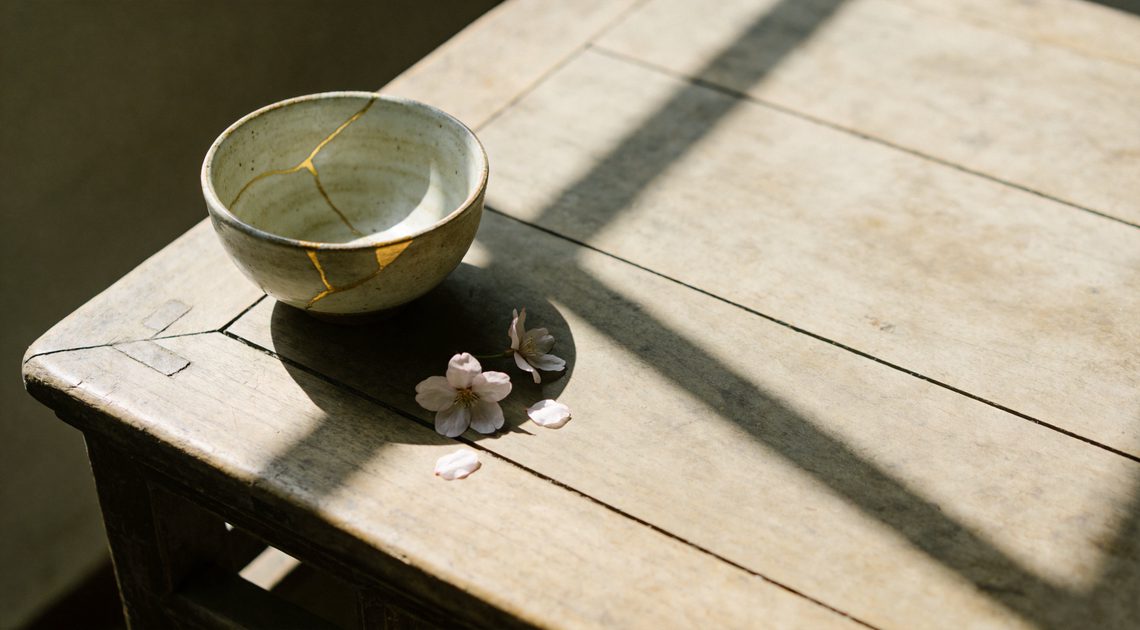
You have probably seen the word before. It appears on lifestyle blogs, on the covers of minimalist design books, in the product descriptions of handmade ceramic cups. Wabi-sabi has become something of a quiet buzzword — a phrase people reach for when they want to describe something that looks beautifully imperfect.
But wabi-sabi is not an aesthetic trend. It is not a decorating style you can replicate by buying the right objects or painting your walls the right shade of beige. It is something older, quieter, and far more radical than that.
Wabi-sabi is a way of seeing. Specifically, it is a Japanese aesthetic philosophy rooted in Zen Buddhism that finds beauty in three things: imperfection, impermanence, and incompleteness. To understand it is not to learn a new design vocabulary. It is to gently unlearn the way Western culture has taught you to evaluate worth.
The Two Words That Make the Whole
To grasp what wabi-sabi means, it helps to separate the two words — not because they are ever truly separate in practice, but because each carries a distinct lineage.
Wabi originally carried connotations of loneliness, of living remotely in nature, of a certain austere simplicity. Over time, especially through its connection to the tea ceremony, it evolved to describe a refined, quiet beauty — the kind found in rustic simplicity, in objects worn by use, in stillness. Think of a weathered wooden bowl, a hut in the mountains, the sound of rain on a thatched roof. Wabi is understated elegance that doesn't ask for attention.
Sabi refers to the beauty that comes with age. The patina on bronze. The crack in a repaired teacup. The fading of dyed fabric after years of light. Sabi is the quiet evidence of time having passed — and having left something more beautiful in its wake. It is the opposite of the Western obsession with newness. A thing is not diminished by age, in this view. It is deepened.
Together, wabi and sabi describe a sensibility that runs through much of traditional Japanese culture: tea ceremony, poetry, pottery, garden design, calligraphy. It is not a checklist. It is a feeling. And it is one that has quietly shaped the way millions of people approach objects, spaces, and even time itself.
Imperfection Is Not a Flaw
Western culture trains us to value symmetry, flawlessness, and finish. A perfect apple. A seamless wall. A life that looks, from the outside, uninterrupted and smooth. We are taught to hide the cracks — in our objects and, too often, in ourselves.
Wabi-sabi asks something different. It asks us to see the crack not as damage, but as history. A piece of pottery repaired with gold-dusted lacquer — the art of kintsugi — is not trying to hide its break. It is announcing, quietly, that the break is part of the story now. The bowl is more beautiful for having been broken, not less.
This is not a consolation prize. It is a radical reframing. When you begin to see imperfection as character, something shifts. The handmade mug with the slightly uneven rim stops feeling like a second choice and starts feeling like the only choice that makes sense. The silence in a room that isn't perfectly styled feels less like emptiness and more like breath.
Impermanence Is Not a Threat
Every spring, cherry blossoms bloom across Japan. They are breathtaking. They also fall within a week.
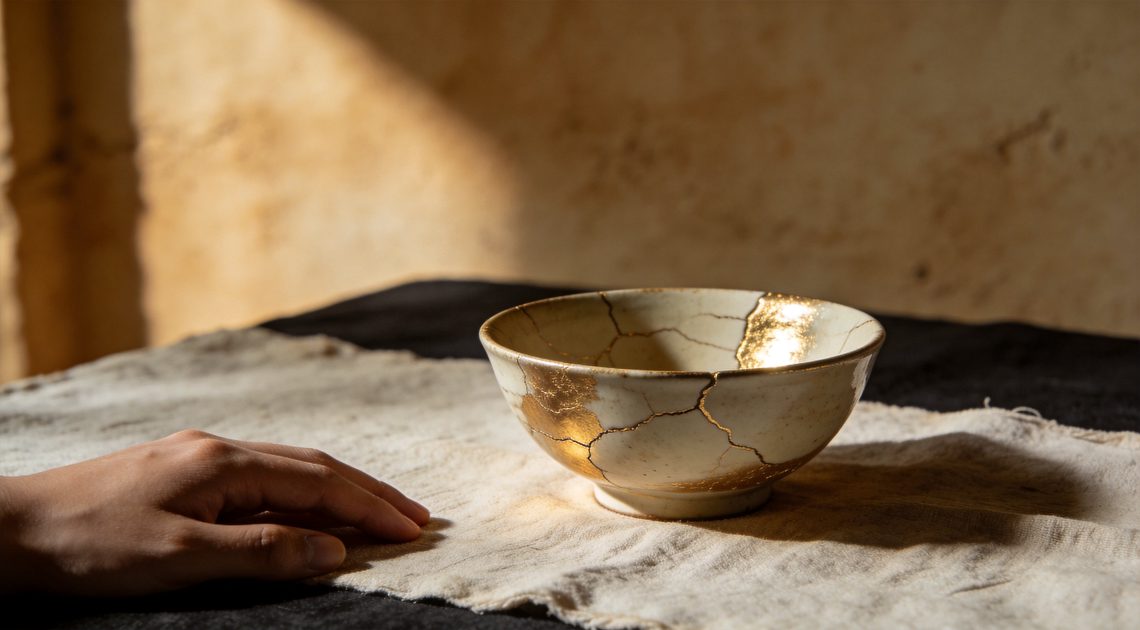
Mono no aware — often translated as "the pathos of things" — is the bittersweet awareness of transience that underpins much of Japanese aesthetic experience. The blossoms are beautiful because they will fall. Not in spite of it. The knowledge of their passing sharpens the attention you bring to them.
Sabi, the aging half of wabi-sabi, is rooted in this same awareness. Objects that show their age — the faded wood, the softened edge, the crack returning to earth — are speaking a quiet truth: nothing stays. And that is not a tragedy. It is an invitation to pay attention now, while the thing is here, in this particular form, with this particular light falling across it.
Incompleteness Is Not a Failure
In the Japanese tradition, a garden is never finished. A scroll is hung, and then changed with the season. A tea gathering ends, and the space is cleared — as if it never happened. There is always a sense of something left open, unresolved, still unfolding.
This is incompleteness as a principle, not a shortcoming. In wabi-sabi, the unfinished object, the asymmetrical arrangement, the empty space in a composition — these are not gaps to be filled. They are places where the viewer, or the dweller, can enter. The room that isn't overcrowded leaves room for you. The story that doesn't spell everything out leaves room for your own quiet reflection.
Bringing Wabi-Sabi Home (Gently)
So how does this land in a life? Not as a shopping list. Not as a "wabi-sabi home decor" checklist that sends you searching for the perfect imperfect vase. That would miss the point entirely.
It starts more quietly than that. It starts with noticing. The way morning light hits the worn edge of a wooden table. The way a handmade bowl feels in your hands — slightly uneven, unmistakably human. The way a room with fewer things can feel fuller, because each thing has room to breathe.
This is where wabi-sabi interior thinking begins. Not with buying, but with seeing what is already here. The objects you already own that carry imperfection, age, and story. The corner of your home that already invites a pause. The textile that has softened with washing, the book with the worn spine, the small stone your child brought home years ago.
To live with wabi-sabi is to gradually, gently, stop fighting the passage of time — in your home, in your objects, in yourself. It is to begin finding beauty in imperfection not as a clever design concept, but as a quiet, daily relief.
Because the truth is, none of us are seamless. We are all kintsugi in progress — cracked, repaired, and somehow more whole for it.



No letters yet — be the first to write.